International LED 2021 (Aberystwyth, UK - Online)
16th International Conference on Luminescence and Electron Spin Resonance Dating (LED 2021)
13-17 September 2021
Host institution
Department of Geography and Earth Sciences, Aberystwyth University, UK
Venue
Online
International Scientific Committee
Geoff Duller (Aberystwyth University, United Kingdom), Lee Arnold (University of Adelaide, Australia), Andrzej Bluszcz (Silesian University of Technology, Poland), Regina DeWitt (East Carolina University, USA), Christoph Falguères (Histoire naturelle de l’Homme préhistorique, France), Mayank Jain (Technical University of Denmark, Denmark), Gloria López (CENIEH, Spain), Morthekai Paulramasamy (CSIR, India), Naomi Porat (Geological Survey of Israel, Israel), Sumiko Tsukamoto (LIAG, Germany), Liping Zhou (Peking University, China)
Proceedings
Quaternary Geochronology (2022)
Short description
Like so much of life in the last few years, the International Luminescence and Electron Spin Resonance Dating conference was severely impacted by Covid-19. It was not possible to hold the 16th International LED conference in 2020 as planned, and instead an online conference was organized. Geoff Duller from Aberystwyth University led an international organizing committee (Lee Arnold, Andrzej Bluszcz, Regina DeWitt, Christophe Falguères, Mayank Jain, Gloria López, Morthekai Paulramasamy, Naomi Porat, Sumiko Tsukamoto and Liping Zhou) in putting together the 16th International Luminescence and Electron Spin Resonance Dating conference (LED2021), which was held between 13th and 17th September 2021.
The academic structure of the conference was similar to previous meetings, with 12 sessions running over 5 days, covering topics including luminescence and electron spin resonance (ESR) processes in different minerals, advances in instrumentation, dose rate determination, application of luminescence and ESR to dating of geological and archaeological materials, approaches for extending the age range, provenance studies using trapped charge methods, and novel applications of luminescence and ESR.
A total of 257 presentations were made at the conference (71 talks and the remainder posters) and 464 colleagues from 41 countries registered for the conference, making it the largest ever held in terms of the number of participants. LED2021 was a truly international conference with participants from time zones ranging from UTC+10 hours (Australia) to UTC-7 hours (West coast of the USA). A website provided online access to all talks and posters for a week before and 3 weeks after the conference itself. The meeting used a combination of Zoom for interactive questions and discussions, and GatherTown for poster sessions and socializing, allowing participants to walk around a virtual conference venue meeting colleagues and chatting, or to look at posters and discuss them with presenters and others.
The manuscripts arising from the conference were submitted for publication to either Radiation Measurements or Quaternary Geochronology as Special Issues of these journals. In this Virtual Special Issue of Radiation Measurements the papers reflect the wide range of investigation of interest to luminescence and ESR dating researchers. They include topics related to: the luminescence and ESR behaviour of minerals, in particular quartz and feldspar, the assessment of the annual dose, new developments in instrumentation, the study of luminescence mechanisms, the characteristics of various minerals and dosimetry phosphors, mathematical modelling, and aspects of dosimetry. The presentations were of an exceptionally high standard, providing a scientifically stimulating atmosphere at the conference.
Four prizes were awarded to students who presented papers at the conference: the Martin Aitken Prize for the best oral presentation on fundamentals was awarded to both Aditi Krishna Dave and Trine Freiesleben, Mariana Sontag-González received the Vagn Mejdahl Prize for the best poster presentation on applications, Joanne Elkadi received the Ann Wintle Prize for the best oral paper on applications, and Nina Ataee received the Peter Townsend Prize for the most innovative idea in instrumentation and methodology.
This text was taken from the Editorial of the Radiation Measurements Special Issue of LED 2021 (Bailiff et al., 2022).
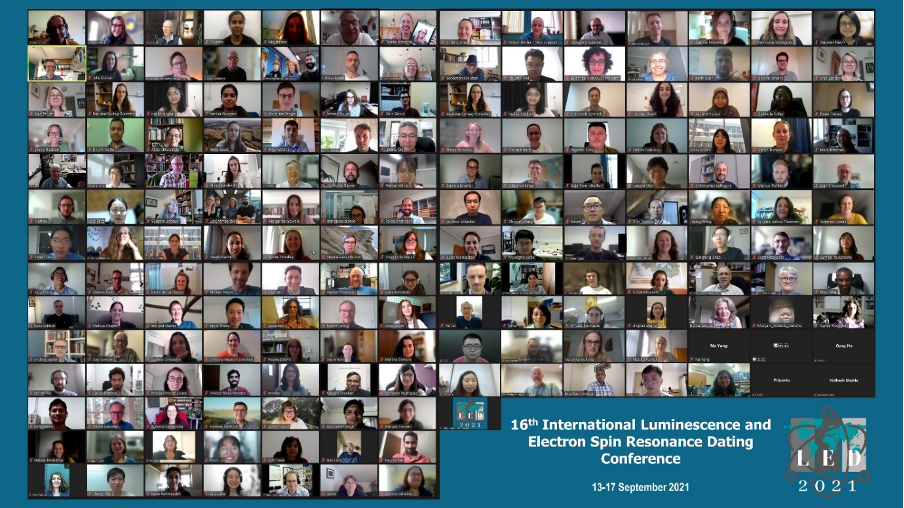
Photo montage of conference delegates by Dr. Gloria I. López